A Typo Fooled Space Weather Scientists for Nearly 180 Years
September 28, 2026
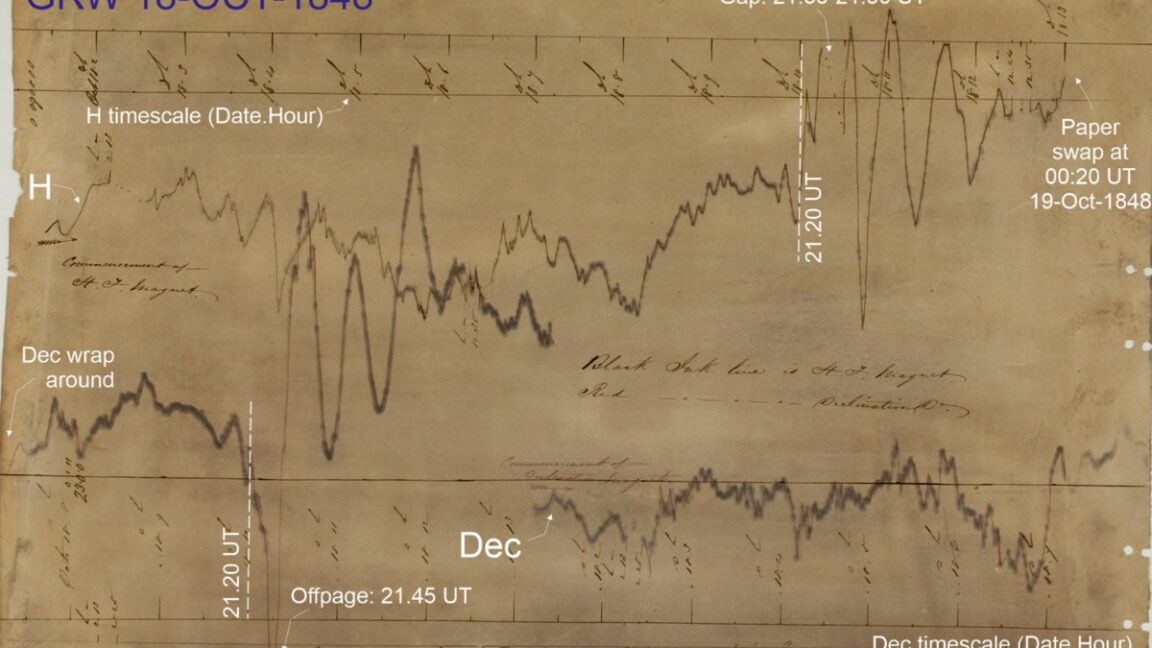
For nearly two centuries, space weather researchers have puzzled over a curious detail buried in the pages of Nature: a report describing how a geomagnetic storm in 1841 disrupted railway signaling equipment and delayed a train. The trouble was that nobody could find a solar storm strong enough, at the right time, to match it. Sunspot records, auroral sightings, and magnetometer logs from that period simply didn't line up with the story.
The mismatch nagged at historians of space weather for years. Geomagnetic storms, triggered by bursts of charged particles from the sun, were known to interfere with telegraph lines throughout the 1800s, so a train delay from the same cause wasn't implausible on its face. What made the case strange was that 1841 fell during a period of unusually low solar activity, making it an odd year for a storm powerful enough to physically disrupt equipment.
Digging back through the original 19th-century source material, researchers now say they've found the answer: a simple transcription error. The year printed in the old Nature account was a typo, off by a single digit from the actual date of the event. Once researchers corrected the year, the train delay lined up neatly with a documented, well-known geomagnetic storm, resolving the mystery and finally reconciling the anecdote with the broader historical record of solar activity.
The finding is more than a footnote for archive nerds. Historical space weather events are one of the few tools scientists have for understanding how often severe solar storms occur and how disruptive they can be to infrastructure, since direct instrumental records only stretch back a couple of centuries. Nineteenth-century newspaper clippings, ship logs, telegraph office reports, and journal notes like the Nature account have become an important dataset for reconstructing that history, especially as modern society grows more dependent on satellites, power grids, and GPS systems that are vulnerable to the same kind of solar activity.
A single misdated entry might seem trivial, but errors like this can ripple through decades of follow-up research if nobody catches them. Studies estimating how frequently extreme storms occur, or comparing historical events to the 1859 Carrington Event, the largest geomagnetic storm on record, rely on accurately dated case studies. A wrongly dated storm can throw off statistical models used to predict the odds of a modern-day repeat, which utilities and satellite operators use for risk planning.
Researchers say the correction is a reminder that historical space weather data, however old and obscure, deserves the same scrutiny as any other scientific record. As solar activity ramps up during the current solar cycle, interest in cataloguing past storms accurately has only grown, since every well-documented historical event adds another data point for predicting how the next major storm might behave, and what it could do to the infrastructure the 1841 telegraph operators could never have imagined.
Reporting based on an external source.